
I started having an increased interest in art during my senior year of high school. I needed an elective, and I thought art would be fun to take. On the first day of class, I took a seat in the front at a table with a little bouquet in a vase. There were different items on every table, letting students choose what piqued their interest. Our teacher asked us to draw what we saw. I got to work. Drawing the lines of the flowers, making them soft and curved, trying to figure out how to get the perspective just right. It was hard. I started to doubt myself. I began telling myself lies. Then I looked over at my neighbor and began to compare my drawing to hers.
During and after this art class, I started painting bare trees. I was obsessed with how jagged the lines were or could be. I loved painting a bare tree. My parents even let me paint one on my wall in my bedroom! I didn’t quite know why I was so drawn to bare trees, but I kept painting or drawing them.
Fast forward to my sophomore year of college. I needed to switch my major. I switched to a degree in Elementary Education, but I needed a major, and I was encouraged to get a minor. I chose Visual Arts as my major. Why? I still don’t know. But I think everything that has happened in the last month is revealing why I was drawn to that major. I also chose English as a Second Language as a minor.
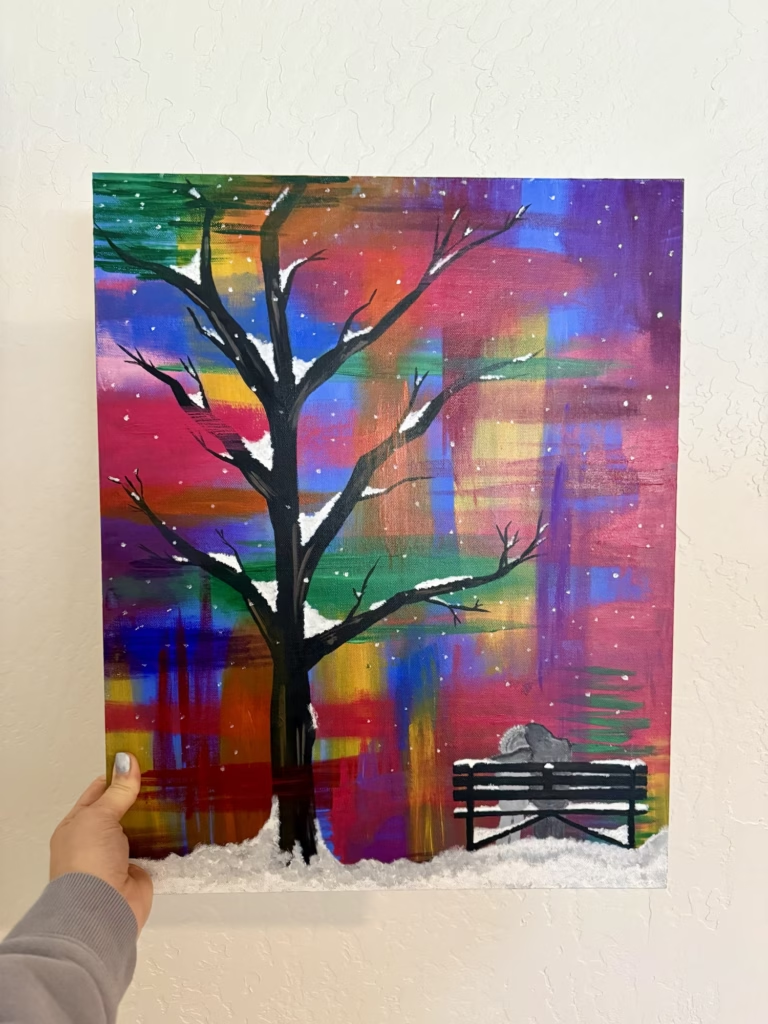
I started with my art classes. And I loved them. It was like going to something I actually felt like I was meant to do every day. I learned so much and learned to appreciate art differently. I took an acrylic class and found myself repainting a bare tree. My teacher encouraged me to add to the painting. So I thought, why not add color? Some people? Snow? Why not? Let’s add it all. The bare tree turned into a winter scene with a couple sitting on a bench. I kept a ton of art and threw a ton of art away, yet this one I still have. I pulled it out and was actually proud of myself. There’s depth, story, and, although the gingham Northern lights is a choice, it’s daring, especially for someone who was scared to use any color because I didn’t yet know how different colors would come out when mixed.
When I finished Rockhouse Counseling, my counselor shared something with me about seeing trees and a verse, and I didn’t quite understand why she was drawn to this collection of art and a verse. But when I told her all that God had spoken to me regarding my identity (read here), she said, “Oh, I know why The Lord drew me to this, it was for you.”
The following week, I did some journaling and research on bare trees. My counselor said something interesting when I told her I was obsessed with painting dead trees when I first started in art. If I didn’t know what to paint, I would paint a dead tree. She said, “Well, now, you’ll paint life back into them. Maybe it describes you in some way?”
As I researched trees, I realized that bare trees don’t necessarily mean they are dead. (Of course!) But what I found was even more revealing. Every fall, the leaves start to die and fall, leaving the tree bare. The leaves have to die so the tree can enter what they call dormancy. It’s a survival state that allows the tree to conserve energy, which is directed to the roots. All that energy the tree would usually be putting out to the leaves is actually put all in the roots, the most essential part of a tree.
This made me think about the tree I had painted in that winter scene. It’s not dead, it’s in dormancy. And maybe, just maybe, my trees that I was painting weren’t dead, but in a state of survival, sending all their energy to their roots so that when the time came, when spring and the warm sun came, the tree would be ready to burst forth with new life.
I am the tree. We are the tree. Our idols, our false beliefs, our comparisons, our fears, etc., are the leaves. Those have to die for our roots to grow deeper in Christ. We can’t love anything more than God. If our priorities are mixed up, our dormancy, our wilderness, will be longer. The original Israelites didn’t go into the Promised Land because of this. They didn’t see themselves the way God saw them. They saw themselves as grasshoppers. Small, insignificant, grasshoppers. Yet, God did not and does not see them or us like that. He calls you by a specific name.
In a wilderness, in dormancy, the growth is slow. It looks and feels desolate, bare, and lacking. But that is where we slowly grow. It’s a slow upward trajectory, just like life. We are on a constant upward trajectory, with low valleys and high mountain tops. But the trajectory will steadily increase. A tree in dormancy looks as though it’s dead, but in actuality, it’s growing stronger so that when the time comes, it’s ready to burst forth with life, color, and new growth.
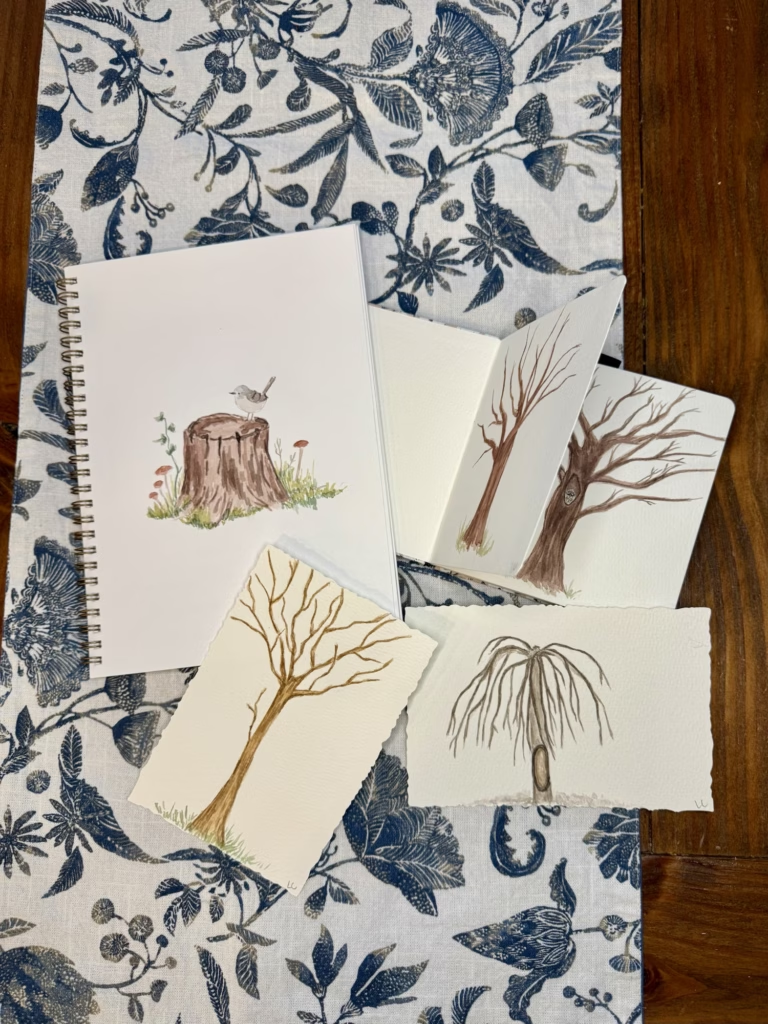
If you didn’t guess by now, this week, I focused on bare trees. My friend got me a little watercolor book, and I painted two bare trees in it, one with an owl. I also painted in an Emily Lex watercolor book, because I felt like the stump fit the theme. The tree at the bottom, I painted while looking at our own weeping cherry tree that we call Noah’s tree. We were gifted this tree when we lost our firstborn, Noah, from my husband’s workplace. It’s been through a move, and a deer rubbing its antlers on the bark – hence the bareness on the bottom where it is healing. It’s been through a lot in its short time being planted, but it continues to grow, and every year the growth is better than the year before. Its roots are strong, deep, and it hasn’t blown over in the windstorms we’ve had.
Life is like that little tree. Life is hard, bare, bursting with life, dormant, and full of growth. Our roots are what will keep us growing on that steady trajectory. As we slowly grow, our roots have time to take hold and go deep, preparing us for spring, when new life shoots forth.
What leaves can you let die today? What one place in your life have you seen growth in?
Read more at The Balm